Progressed chart calculator: your progressed Moon dates, and how to read them
Free progressed chart and progressed Moon calculator: your dates sign by sign, the progressed lunation cycle, and a three-clock method for reading progressions.
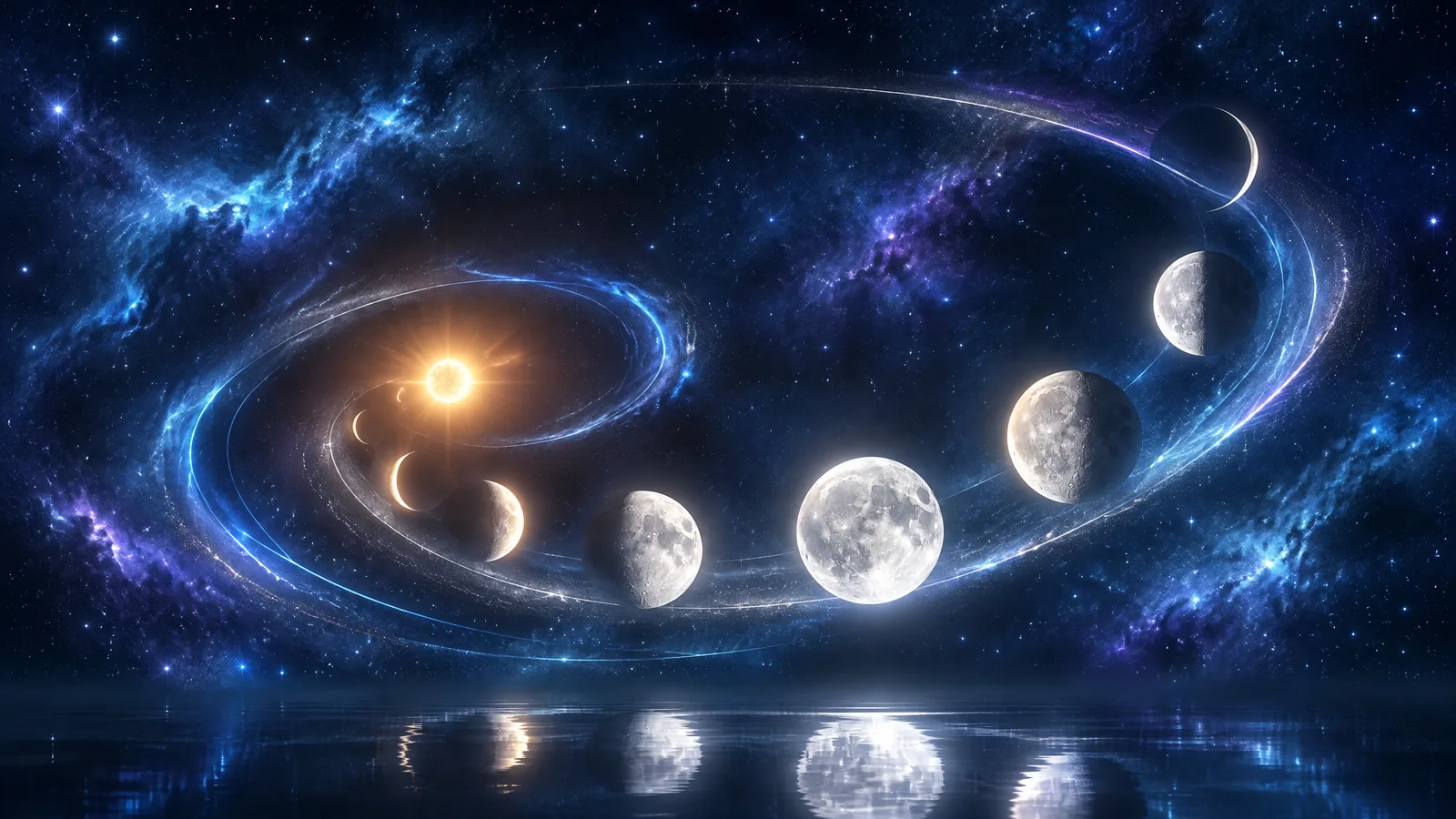
Quick answer · Calculator · Dated example
Your birth chart never moves. Yet you no longer need what you needed at twenty. A progressed chart tracks that change: it moves your chart forward one day for every year of life, and the progressed Moon, which changes sign about every two years and three months, sets the pace.
This article calculates your progressed chart and every date of your progressed Moon, then gives you a simple way to read them: three clocks, from the fastest to the slowest.
Progressed Moon
About 13° a year
Time in one sign
23 to 31 months
Progressed lunation
29.5 years
The short answer
A progressed chart is the sky of the days after your birth, one day for each year of life: at 40, it is the sky of the 40th day. You read it on top of your natal chart. The progressed Moon, moving about 13° a year, is its liveliest part: it changes sign every two years and three months on average, changes house at roughly the same pace, and goes around the zodiac in 27.3 years. It describes what you need right now. The progressed Sun changes sign only every thirty years.
Key takeaways
- Your progressed chart for year N is the sky of the Nth day after birth, at the same time of day.
- The progressed Moon stays two years and three months in a sign on average (23 to 31 months), not two and a half years.
- Read it with three clocks: the Moon (the climate), the progressed lunation (a 29.5-year season), the Sun (a thirty-year era).
- One hour of error in your birth time shifts every date by fifteen days. With no birth time, allow six months.
- A progression describes a ripening, a transit sets it off: read them together.
What a progressed chart is
The rule fits in one line: each day after birth stands for one year of life. The sky on day 10 describes your tenth year, the sky on day 30 your thirtieth. The planets’ positions on that day form the progressed chart, which you lay over the natal chart to see what has moved.
A concrete case. For someone born on November 1, 1971, at 10:15 a.m., the progressed chart for November 2026, at age 55, is the sky of December 26, 1971, around noon. Between those two dates the Moon went around the zodiac a little more than twice, the Sun moved 56°, and Saturn, retrograde, slipped back four degrees.
The idea is old. The Bible already states it (“I have appointed thee each day for a year,” Ezekiel 4:6, King James Version), traces of it appear in the astrologer Vettius Valens in the 2nd century, and the method is often credited to Placidus de Titis (1603–1668). It is also called secondary directions. The English astrologer Alan Leo made it popular in the early 20th century with The Progressed Horoscope.
Not everything moves at the same speed. Only the Moon, Sun, Mercury, Venus and Mars move enough to matter. Jupiter travels 21° at most in a lifetime; Uranus, Neptune and Pluto a few degrees. The table, based on 1,500 random births between 1900 and 2015, shows what to watch.
| Planet | Progressed speed | Over 90 years | What to watch |
|---|---|---|---|
| Moon | 11.8° to 15.4° a year | More than three trips around the zodiac | Sign, house, aspects to natal points |
| Sun | 0.95° to 1.02° a year | About 90°, three signs | Sign changes, aspects to natal planets |
| Mercury | Up to 2.2° a year, sometimes retrograde | Up to 136° | Changes of direction |
| Venus | Up to 1.26° a year | Up to 113° | Changes of direction, aspects |
| Mars | Up to 0.79° a year | Up to 71° | Changes of direction, aspects |
| Jupiter | Up to 0.24° a year | 21° at most | Rarely useful |
| Saturn | Up to 0.13° a year | 11° at most | Rarely useful |
| Uranus, Neptune, Pluto | Under 0.07° a year | 3 to 5° at most | Practically still |
Calculate your progressed chart
You need your birth date, birth time and time zone. The exact birthplace only matters for houses and angles: the calculator does not compute them, but you can enter your Ascendant or any other point in your chart to date the progressed Moon’s passes over it.
Calculate your progressed chart
Enter your birth date, birth time and the time zone of your birthplace. Everything is calculated in your browser: nothing is sent or stored.
Secondary progressions, one day for one tropical year. Moon computed with the ELP-2000/82 theory (Meeus), planets with JPL orbital elements, checked against the Swiss Ephemeris from 1900 to 2050: Moon within 17″, planets within 3′ 30″ at worst. One hour of error in the birth time shifts every date by 15 days. Progressed Ascendant and houses are not computed (they need the exact birthplace).
How to read the result
Start with the first line: the sign of your progressed Moon and the dates of its stay. Then read the phase of the progressed lunation, and the sign of the progressed Sun. The ten-planet table helps you spot exact aspects to natal planets: allow one degree of orb, about one month either side for the Moon and one year for the Sun.
The Moon travels 13° a day: one hour of error moves it half a degree, and shifts every date in the progressed chart by fifteen days. With a time rounded to the quarter hour, dates stay within two days. With no time at all, only the signs of the Sun and planets stay reliable; our guide to a birth chart without a birth time shows how to work with that.
The three clocks: Moon, lunation, Sun
Read a progressed chart like a watch with three hands. The progressed Moon is the second hand: it gives the climate of the current two or three years. The progressed lunation, the angle between the progressed Moon and Sun, is the minute hand: it places that climate within a 29.5-year season. The progressed Sun is the hour hand.
| Clock | One step | Full cycle | What it describes |
|---|---|---|---|
| Progressed Moon | One sign every 2 years and 3 months on average | 27.3 years | The emotional climate: what you need right now, and where you go looking for it. |
| Progressed lunation | One phase every 3 years and 8 months | 29.5 years | The season: sowing, building, harvesting, passing on, then preparing the next cycle. |
| Progressed Sun | One sign every 30 years or so | 2 or 3 signs in a lifetime | The era: the style of identity you take on for a long stretch. |
Order matters. Look first at where the progressed Moon is, by sign and house; then at the phase of the lunation; last at the sign of the progressed Sun, which sets the backdrop. When all three clocks chime in the same year, with a sign change, a phase change and an exact aspect, that period deserves your full attention.
Two and a half years per sign? Closer to two years and three months
Nearly every site says the progressed Moon spends two and a half years in each sign. We measured it: across 400 random births between 1900 and 2015, or 15,397 sign stays, the average is 2 years and 3 months (2.28 years).
The shortest stay lasts 23 and a half months, the longest 30 and a half. Only 15% of stays reach the two and a half years so often quoted.
The gap comes from the Moon itself: its speed ranges from 11.8° to 15.4° a day depending on its distance from Earth. Someone born with a fast Moon moves through the signs in barely two years; a slow Moon takes two and a half. The calculator gives your real dates, and they matter more than the average.
The progressed Moon cycle: 7, 14, 20 and 27 years
Around its natal position, the progressed Moon traces a cycle in four beats: a square to the natal Moon around age 7 (between 6 and 7½), an opposition around 13½, a second square around 20½, and a return around 27 years and 4 months. The same rhythm then repeats, with returns around 55 and 82.
The rhythm echoes Saturn’s (7, 14, 21 and 29), and the two cycles often mark the same rites of passage. They are not the same thing, though. The Saturn return is a transit, an outside deadline; the progressed lunar return is an inner, emotional review that comes two years before it the first time, and four years before it the second.
A dated example, step by step
Take the site’s demonstration chart, already worked through in the article on the dominant planet: November 1, 1971, 10:15 a.m., Troyes, France, or 9:15 Universal Time. The natal Moon sits at 16° 52′ Aries in the 4th house, 158° ahead of the Sun: a birth in the gibbous phase, just before a Full Moon.
The first consequence: the first progressed Full Moon comes at age one and a half, and the first progressed New Moon at 16 years and 8 months. The natal Moon is also fast (15.2° a day), so in childhood it changes sign about every two years. The table shows what the three clocks mark between 2018 and 2028.
| Date | What happens in the progressed chart |
|---|---|
| Mar 29, 2018 | Progressed New Moon at 25° Sagittarius, in the 1st house: a 29.5-year cycle begins. |
| Dec 18, 2022 | The progressed Sun enters Capricorn, for thirty years (until May 2052). |
| Apr 25, 2023 | Progressed Mercury turns direct at 11° 58′ Sagittarius, after a retrograde phase that began in July 2003. |
| Apr 30, 2025 | The progressed Moon enters Aries, the sign of the natal Moon. |
| Jul 6, 2025 | Progressed First Quarter: the progressed Moon squares the progressed Sun. |
| Jul 19, 2025 | The progressed Moon crosses the IC into the 4th house, the house of the natal Moon. |
| Jun 3, 2026 | Progressed Moon opposes natal Uranus (15° 28′ Libra). |
| Jul 9, 2026 | Second progressed lunar return, at 16° 52′ Aries, at age 54 years and 8 months. |
| Jun 9, 2027 | The progressed Moon enters Taurus; twelve days later, the 5th house. |
| Nov 23, 2028 | Gibbous phase of the progressed lunation. |
The reading follows the three clocks. The second hand first: between April 2025 and July 2026, the progressed Moon returns to the sign of the natal Moon, enters the house of the natal Moon, then crosses the natal Moon itself. Three signals on one theme, home and roots, in fourteen months.
Then the minute hand: the progressed First Quarter of July 2025 is a building phase, the third of the cycle that opened in 2018. Then the hour hand: a progressed Sun in Capricorn since 2022 gives the whole period a backdrop of structure and long-term goals. What the progression does not say is the concrete form: for that, look at the transits of the same months.
In this chart, cast in Placidus houses, the 6th house spans only 17° and the 2nd almost 43°. The progressed Moon crosses the first in a year and two months, the second in more than three years. That is why the usual “per house” durations mean little without your own chart; our guide to house cusps explains where the differences come from.
The progressed Moon through the twelve signs
The sign of the progressed Moon colors what you need at the moment. It is not a change of personality: your natal Moon stays the foundation, and the progressed sign is the season it is going through. For each sign, the table gives the main need, what helps meet it and the most common trap.
| Progressed Moon in | What you need now | What helps | The trap |
|---|---|---|---|
| Aries | To act, start over, depend on no one | A new project, movement, quick decisions | Leaving before you understand |
| Taurus | Security, slowness, comfort | A stable place, steady income, the body | Clinging to what no longer feeds you |
| Gemini | To learn, talk, get around | A course, writing, plenty of conversations | Scattering yourself so you don’t have to feel |
| Cancer | A home, closeness, family | Your own place, ties that protect | Withdrawal, touchiness |
| Leo | To be seen, create, love | A body of work, a role, an audience | Living on applause |
| Virgo | Order, usefulness, health | A routine, a skill being refined | Self-criticism on a loop |
| Libra | The other person, agreement, beauty | A partnership, art, mediation | Erasing yourself to keep the peace |
| Scorpio | Truth, intensity, transformation | A passion, inner work, what you dare to look at | Control, suspicion |
| Sagittarius | Meaning, horizon, freedom | Travel, study, a conviction | Escaping into the next plan |
| Capricorn | Structure, responsibility, results | A long-term goal, discipline | Coldness, carrying everything alone |
| Aquarius | Independence, friendship, novelty | A group, a cause, a change of setting | Detaching so nothing can touch you |
| Pisces | Retreat, imagination, compassion | Rest, music, caring for others | Confusion, escapism |
Two markers sharpen the reading. The progressed Moon comes back to the same element about every nine years: Fire, Earth, Air, Water, in that order, three times per cycle. And its stay in the sign opposite your natal Moon, around 14 and again around 41, is usually the most unfamiliar: you learn a need you did not know you had.
The progressed Moon through the houses
The house shows where your attention goes. The most common practice follows the progressed Moon through the natal houses, which takes a reliable birth time. It spends a little over two years in each house on average, much less in a small house, more in a large one.
| House | Where attention goes | A sign it is going well |
|---|---|---|
| 1st | Yourself, your body, your image | You make a decision for yourself without asking permission. |
| 2nd | Money, resources, self-worth | The numbers add up, and you know what you are worth. |
| 3rd | Learning, writing, siblings, short trips | A new skill, a voice that opens up. |
| 4th | Home, family, roots | The place you live ends up looking like you. |
| 5th | Creating, loving, children, pleasure | Something is born from you, and you are proud of it. |
| 6th | Daily work, health, routines | Your days reorganize to carry you, not wear you down. |
| 7th | Partner, associates, contracts | A relationship becomes clear, one way or the other. |
| 8th | Intimacy, shared money, crises | You shed an old skin without regret. |
| 9th | Meaning, study, travel, beliefs | Your horizon widens, literally or not. |
| 10th | Career, reputation, public standing | You are recognized for what you have built. |
| 11th | Friends, networks, group projects | You find your allies and a project to share. |
| 12th | Retreat, the unconscious, the end of a cycle | You sort things out before setting off again: the Moon will soon cross the Ascendant. |
The four angles are the clearest crossings: the Ascendant (you put yourself back at the center), the IC (you come home), the Descendant (someone else takes up room), the Midheaven (you step into view). Enter their degrees in the calculator’s “a point in your chart” field to get their dates. Each house is covered in detail in our guide to the twelve houses.
Progressed New Moon and Full Moon
The progressed lunation follows the angle between the progressed Moon and the progressed Sun. Just as the Moon in the sky does in 29.5 days, the progressed Moon goes through New Moon, First Quarter, Full Moon and Last Quarter in 29.5 years. The cycles we measured run from 29 years and 3 months to 29 years and 10 months.
The astrologer Dane Rudhyar gave this cycle its modern reading in The Lunation Cycle (1967), with eight phases of 45°. Each lasts about three years and eight months. The Moon’s phase at your birth sets the starting point: born just after a New Moon, you wait until about 29 for the next one; born at a Full Moon, you meet it around 15.
| Phase | Moon–Sun angle | What is at stake |
|---|---|---|
| New Moon | 0° to 45° | Sowing. A new direction takes shape, still blurry; you act on instinct. |
| Crescent | 45° to 90° | Breaking away from the old. The drive is there, habits push back. |
| First Quarter | 90° to 135° | Building. A crisis in action: you have to choose and build for real. |
| Gibbous | 135° to 180° | Refining. You adjust, train and prepare the culmination. |
| Full Moon | 180° to 225° | Harvest and clarity. What was sown becomes visible; relationships matter. |
| Disseminating | 225° to 270° | Passing on. You share what you have learned, teach, publish. |
| Last Quarter | 270° to 315° | Reorienting. A crisis in consciousness: you drop forms that have grown too narrow. |
| Balsamic | 315° to 360° | Closing. A fertile retreat, letting go of old plans, the seed of the next cycle. |
The sign and house of the progressed New Moon set the theme of the whole cycle. In the example, the New Moon of March 2018 falls at 25° Sagittarius in the 1st house: a cycle centered on the person and on what they believe. The next progressed Full Moon, in April 2032, will show what came of it.
This 29.5-year cycle runs almost as long as Saturn’s (29.45 years), but the two are not in step: a progressed New Moon can fall at any age. If you want to follow the real sky’s lunations, you need the lunar calendar, not the progressed chart.
Progressed Sun, Mercury, Venus and Mars
The progressed Sun moves one degree a year. It changes sign two or three times in a lifetime, the first time between birth and age 31 depending on its natal degree. Each change opens an era of about thirty years: a natal Scorpio Sun that progresses into Sagittarius, then Capricorn, keeps its nature but changes how it shows it.
Progressed Mercury, Venus and Mars matter mostly through their changes of direction. Across 3,000 random births between 1930 and 2010, progressed Mercury changes direction at least once before age 90 in 97% of cases, and 19% of people are born with Mercury retrograde. Venus and Mars change direction for only 22% of people.
A progressed station is nothing like a flash. The planet stays almost still for years around one degree, which becomes highly sensitive. In the example, progressed Mercury, retrograde from 2003 to 2023, spent nearly twenty years retracing its steps: a mind turned toward review rather than conquest. Our guide to retrogrades covers what each retrograde planet means.
The Ascendant and Midheaven progress too, about one degree a year for the Midheaven. They need the exact birthplace and a chosen method (solar arc, Naibod), and a few minutes of error in the birth time moves them a degree, which is a year. That is why the calculator leaves them out; your chart software will handle them.
Progressions or transits: which does what
Forecasting techniques do not compete: they measure different things at different speeds. The table compares them on what counts in practice.
| Technique | What it measures | Pace | Birth time | Used for |
|---|---|---|---|---|
| Transits | Today’s real sky compared with your natal chart | From a few days to two years | Useful for houses | Timing a trigger |
| Secondary progressions | The sky of the days after birth, one day for one year | From a few months to thirty years | Critical: 1 hour = 15 days | Reading a life chapter, a slow ripening |
| Solar return | The chart of the Sun’s return to its natal position | One year | Exact time and place | The year’s agenda |
| Solar arc | The whole chart moves forward by the arc of the progressed Sun | About 1° a year | Useful for the angles | Timing contacts to the angles |
In practice, look for a double signature. When a progression and a slow transit hit the same planet or house in the same year, the period matters; a progression on its own stays a background climate. The solar return then places the year within that climate, and our article on the major transits of 2027 describes the collective sky of the moment.
It does not replace the natal chart and does not predict events. At any moment, roughly one person in twelve has their progressed Moon in the same sign as yours: what makes the reading personal is the house, the aspects to your natal planets and the overlap with your transits. A reading that stops at the sign is still a horoscope.
Frequently asked questions about progressed charts
How do I calculate my progressed chart?
Count one day after birth for each year of life: at 40, your progressed chart is the sky of the 40th day after you were born, at the same time of day. The calculator in this article does it for you from your birth date, birth time and time zone, and lists every date your progressed Moon enters a new sign.
How long does the progressed Moon stay in a sign?
Two years and three months on average, not the two and a half years you often read. Depending on how fast the Moon was moving in the days after your birth, a stay lasts 23 to 31 months, and only 15% of them reach two and a half years. The progressed Moon goes all the way around the zodiac in 27 years and 4 months.
Do I need my birth time for a progressed chart?
Yes for the Moon and the houses. One hour of error in your birth time shifts every date in the progressed chart by fifteen days. Without a time, the chart is cast for noon: the progressed Moon may be off by up to 7° and its dates by six months. The signs of the Sun and the slow planets stay reliable.
What is the difference between a progressed chart and transits?
Transits compare today’s real sky with your natal chart: they are outside triggers, often brief. A progressed chart moves your own chart forward at its own pace, one day for one year, and describes an inner ripening over months or years. Read them together: the progression gives the theme of the chapter, the transit gives the date.
What is a progressed New Moon?
It is the moment the progressed Moon catches up with the progressed Sun. It comes around every 29 and a half years and opens a new eight-phase cycle, described by Dane Rudhyar in 1967. The age of your first progressed New Moon depends on the Moon’s phase at birth: around 15 if you were born at a Full Moon, around 29 if you were born just after a New Moon.
What happens at a progressed lunar return?
The progressed Moon comes back to the natal Moon around age 27, 55 and 82. It closes a full emotional cycle: the needs of your natal Moon return to center stage, with experience added. It is a time of inner stock-taking, often tied to home and family, especially when it coincides with a slow transit to the Moon or the IC.
Sources
- Sign durations, cycles, stations and the dated example: the author’s calculations with the Swiss Ephemeris (Astrodienst), over 400, 1,500 and 3,000 random births between 1900 and 2015.
- Jean Meeus, Astronomical Algorithms (Willmann-Bell, 2nd ed., 1998), chapter 47: the lunar theory used by the calculator.
- E. M. Standish and J. G. Williams, Approximate Positions of the Planets (JPL, NASA): planetary elements valid from 1800 to 2050.
- Moon Fact Sheet (NASA): sidereal period of 27.3217 days, synodic month of 29.53 days.
- Dane Rudhyar, The Lunation Cycle (1967): the eight phases of the lunation and the progressed lunation.
- Alan Leo, The Progressed Horoscope (London, early 20th century), the textbook that made the method popular.
Keep reading
Got your progressed Moon? Go back to what your natal Moon says, then to our page on the Moon: the progression only makes sense against it.
To time the triggers, move on to our guide to transits. And if a term stops you, the astrology dictionary defines progression, lunation, station and orb.