Dominant planet: finding it with the seven-weights grid
Find your dominant planet without an opaque calculator: a published seven-criteria scoring grid, a real chart worked end to end, and a rule for breaking ties.
Method · Scoring · Worked example
You type your birth date into a calculator, it announces “Uranus dominant”, and you have no idea how it got there. That is not a problem of belief. It is a problem of method.
Here is the scoring grid I have used in consultation for years: seven criteria, explicit point values, and a result you can reproduce by hand. So that it does not stay theoretical, I run it end to end on a real chart — my own — and publish the birth data so you can check every line.
What we are after
The planet running the chart
What we measure
Position, rulership, aspects
The key question
Which planet would be missed most if it vanished?
Definition
The dominant planet of a natal chart is the one that accumulates the most factors of strength: it rules the Ascendant, sits on an angle, holds a direct link to the Sun or the Moon, occupies a sign where it is at home, and receives many aspects. You find it by scoring every planet on those criteria and adding up. It describes a person’s main drive — what they do spontaneously when nobody is telling them what to do.
In short
- There is no official scoring scale. The one worth using is the one that is published, and therefore checkable.
- The two heaviest criteria are rulership of the Ascendant and conjunction to an angle.
- Your chart ruler is not automatically your dominant planet — it is one criterion out of seven.
- A gap of 4 points or more between first and second means a clear dominant. Under 2 points, you have two.
- Without a reliable birth time the calculation is worthless: one hour is enough to change the answer.
What a dominant planet is
A dominant planet is not your favourite planet, and it is not the ruler of your Sun sign. It is the one whose voice drowns out the others in the natal chart: it sets the tempo, the question, the way problems get solved. When someone who barely knows you describes you in three words, they are almost always describing your dominant — not your Sun.
What it is
- The engine: what the person does by default.
- The outcome of a weighted score, not an impression.
- An actor, named by a planet — and therefore a planetary type described since antiquity.
- Often two planets rather than one.
What it is not
- The dominant sign: that gives the manner, not the engine.
- The dominant house: that gives the field of play.
- The planet closest to the Sun, or the fastest one.
- A fixed label: it describes how someone works, not what they are worth.
If you removed this planet from the chart, what would collapse first? A Saturn dominant gone is the backbone gone. A Mercury dominant gone is the link to other people. The test does not replace the calculation, but it validates its result.
Chart ruler vs dominant planet
In English-language astrology these two get used interchangeably, and several popular calculators even put them in the same sentence. They are not the same thing, and the difference matters.
Your chart ruler is the planet that rules your Ascendant sign. It is a single fact, read off the chart in two seconds, and it does not depend on anything else. Your dominant planet is the result of weighing the whole chart. The chart ruler is one of the seven criteria below — the heaviest one, worth 5 points — which is why the two frequently coincide. Frequently is not always.
Picture a Virgo Ascendant whose Mercury sits in the 12th house, in Leo, with no major aspect — a chart ruler with 5 points and nothing else. Now put Saturn on the Midheaven, in Capricorn, square the Sun. Saturn collects angularity, dignity and aspects, and finishes well ahead. The chart ruler still describes the doorway; Saturn describes the person walking through it.
Why no calculation is official
Three online calculators, three different dominants for the same chart. It is a routine experience, and a discouraging one. The explanation is simple: no astrological authority ever fixed a scoring scale the way a standards body fixes a paper size. Each school built its own, around whatever it considers decisive.
Traditions before the twentieth century reasoned in essential dignities and significators: a strong planet was a planet in its domicile or exaltation. Twentieth-century astrology added the weight of angularity — the idea that a planet sitting on an angle shows up in behaviour. Psychological astrology favours aspects to the luminaries. None of these three is refuting the others; they are answering slightly different questions.
Not that it be true — nobody can demonstrate that — but that it be explicit. A published scale can be argued with, corrected, reproduced by anyone. A calculator that will not say how it counts is asking you to take its word for it. The grid below is published in full, so you can contest every point value in it. That is exactly the point.
The seven-weights grid
Seven criteria, each measuring a different way of being strong in a chart. You score the ten planets on every row, add up, and rank. A table of ten rows and seven columns is all it takes, and the full calculation runs to about twenty minutes the first time.
The complete scale, criterion by criterion
| Criterion | What you look at | Points |
|---|---|---|
| 1. Rulership of the Ascendant | The planet that rules the Ascendant sign — your chart ruler. | 5 pts — or 3 + 3 where the sign has two rulers (Scorpio, Aquarius, Pisces). |
| 2. Angularity | Distance to the nearest of the four angles: Ascendant, Midheaven, Descendant, IC. | 4 pts within a 3° orb, 2 pts between 3 and 8°. Failing that, 2 pts for a planet in house I, IV, VII or X. |
| 3. Link to the luminaries | The Sun and Moon themselves, and the planets ruling the signs they occupy. | 2 pts for each luminary · 2 pts to the Sun’s dispositor · 2 pts to the Moon’s dispositor (1 + 1 where the sign has two rulers). |
| 4. Stellium | Three or more planets gathered in one sign or in one house. | 1 pt to each member · 2 pts to the ruler of the sign involved (1 + 1 where there are two). |
| 5. Essential dignity | How strong the planet is in the sign it occupies. | Domicile + 3 · exaltation + 2 · peregrine 0 · fall − 1 · detriment − 2. |
| 6. Aspects received from the strong points | Major aspects to the Sun, the Moon, the Ascendant or the Midheaven. | 2 pts per aspect within 3°, 1 pt out to 8° (6° for the sextile). Capped at 4 pts. |
| 7. Most aspected planet | The highest count of major aspects to the other planets. | 2 pts, shared in the event of a tie. |
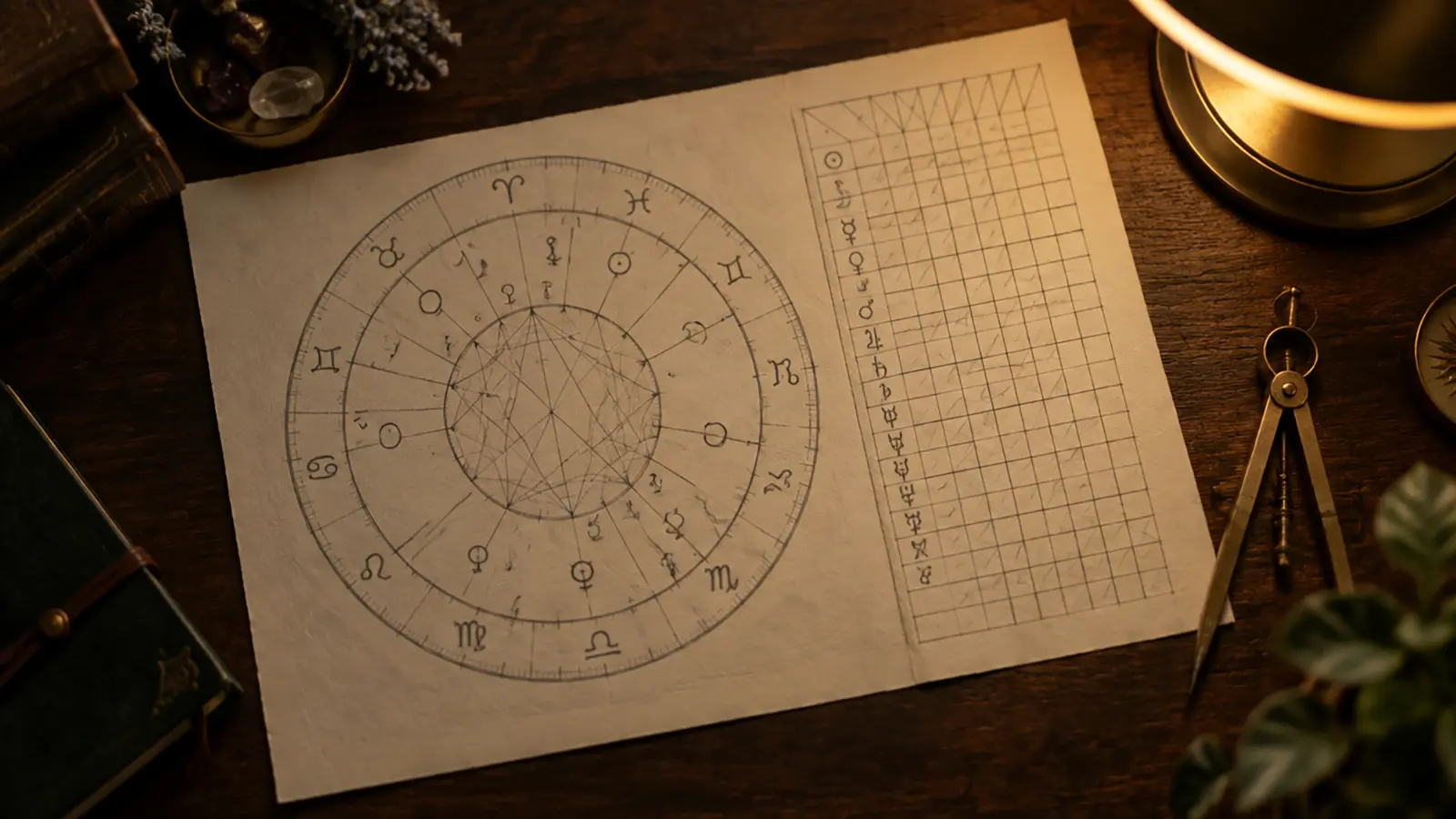
Worksheet
The blank table to fill in by hand: ten planets, seven columns, the full scale on the back. Print two — one for your chart, one for someone you know well.
Download the worksheet (PDF, 2 A4 pages)Three scoring decisions, stated out loud
Rulership of the Ascendant costs the most. In the tradition, the ruler of the Ascendant is the ruler of the whole chart. A planet that governs the doorway governs what comes in and what goes out.
A conjunction to an angle counts twice, and that is deliberate. It scores under criterion 2 (position) and under criterion 6 (aspect received). A planet glued to the Ascendant is the single most immediately visible thing in a chart: you read it in the face, the walk, the first three minutes of a conversation. It is the only double-count in the scale.
The luminaries do not start out ahead. The Sun and Moon get a base of 2 points each, no more. What gives them weight is their dispositors — the planet ruling the sign they sit in. A Sun in Scorpio strengthens Mars and Pluto, not the Sun.
8° for major aspects involving the Sun, Moon, Ascendant or Midheaven, 6° between two other planets, and 2° less for the sextile. These are classical orbs, deliberately tight: a scale that is generous with orbs ends up giving points to everybody. See the aspects page for the detail.
The worked chart
A grid without a finished example is useless. So here is mine, birth data included, so you can recalculate it in whatever software you use and check every line.
Birth data
1 November 1971, 10:15, Troyes (Aube, France) — 48° 18′ N, 4° 04′ E.
French legal time was UTC+1. France observed no summer time between 1945 and 1976 — it was only reinstated by decree no. 75-866 of 19 September 1975, effective March 1976. Universal time of birth is therefore 09:15 UT, with no further correction.
Positions calculated with the Swiss Ephemeris, tropical zodiac, Placidus houses.
| Planet | Position | House | Worth noting |
|---|---|---|---|
| Sun | 8° 17′ Scorpio | XI | Peregrine |
| Moon | 16° 52′ Aries | IV | Angular house |
| Mercury | 22° 47′ Scorpio | XII | Peregrine |
| Venus | 25° 28′ Scorpio | XII | Detriment |
| Mars | 27° 22′ Aquarius | III | Peregrine |
| Jupiter | 8° 54′ Sagittarius | I | Domicile · conjunct ASC 0° 47′ |
| Saturn | 4° 56′ Gemini ℞ | VI | Conjunct DS 3° 11′ |
| Uranus | 15° 28′ Libra | X | Angular house |
| Neptune | 1° 54′ Sagittarius | XII | Conjunct ASC 6° 13′ |
| Pluto | 0° 57′ Libra | IX | Conjunct MC 2° 08′ |
Ascendant 8° 07′ Sagittarius, Midheaven 3° 05′ Libra. Two stelliums: three planets in Scorpio (Sun, Mercury, Venus) and three in the 12th house (Mercury, Venus, Neptune), whose cusp falls in Scorpio.
Scoring, planet by planet
Only the top five are detailed here: beyond that the scores no longer change the outcome. The full ranking follows.
Jupiter: 16 points
The Ascendant is in Sagittarius, and Sagittarius has only one ruler — Jupiter takes the 5 points of criterion 1. It is also conjunct that Ascendant within 47 minutes of arc, comfortably inside the 3° band: 4 points under criterion 2, then 2 more under criterion 6 for the same aspect. It sits in Sagittarius, so it is in domicile: 3 points. A sextile to the Midheaven and a trine to the Moon add 1 point each, which caps criterion 6 at 4.
Total: 5 + 4 + 3 + 4 = 16 points. No other planet reaches half of that.
Pluto: 8 points
Pluto borders the Midheaven within 2° 08′: 4 points of angularity, 2 points of aspect received. As the modern ruler of Scorpio it is co-dispositor of the Sun (1 pt) and ruler of both stelliums (1 + 1). Against that, it is in fall in Libra, which costs 1 point. Total: 8.
Neptune: 8 points
Neptune is conjunct the Ascendant too, but at 6° 13′ — in the second band, so 2 points only, plus 1 for the aspect. Its sextile to the Midheaven, however, is tight at 1° 11′: 2 points. A member of the 12th-house stellium (1 pt), it is also one of the three most aspected planets in the chart (2 pts). Total: 8, level with Pluto.
Mars and Saturn: 7 points each
Mars touches no angle and holds no dignity, but it rules Aries where the Moon sits (2 pts), co-rules Scorpio where the Sun sits (1 pt), rules both stelliums (2 pts) and is among the most aspected (2 pts). It climbs to 7 without ever being visible — the textbook case of a planet that weighs through rulership rather than position. Saturn reaches the same total by the opposite route: conjunct the Descendant within 3° 11′ and tightly trine the Midheaven.
The ranking and how to read it
| Rank | Planet | Total | Where the points come from |
|---|---|---|---|
| 1 | Jupiter | 16 | Chart ruler (+5), conjunct the Ascendant within 47′ (+4), in domicile (+3), aspects to the strong points (+4). |
| 2 | Pluto | 8 | Conjunct the Midheaven within 2° 08′ (+4 and +2), co-dispositor of the Sun and ruler of both stelliums (+3), in fall in Libra (−1). |
| 3 | Neptune | 8 | Conjunct the Ascendant within 6° 13′ (+2 and +1), tight sextile to the Midheaven (+2), member of the 12th-house stellium (+1), joint most aspected (+2). |
| 4 | Mars | 7 | Dispositor of the Moon (+2) and co-dispositor of the Sun (+1), ruler of both stelliums (+2), joint most aspected (+2). |
| 5 | Saturn | 7 | Conjunct the Descendant within 3° 11′ (+2 and +1), tight trine to the Midheaven (+2), joint most aspected (+2). |
| 6 | Moon | 4 | Luminary (+2), in the angular 4th house (+2). |
| 7 | Uranus | 4 | In the angular 10th house (+2), tight opposition to the Moon (+2). |
| 8 | Sun | 3 | Luminary (+2), member of the Scorpio stellium (+1). |
| 9 | Mercury | 2 | Member of both stelliums (+2). |
| 10 | Venus | 0 | Member of both stelliums (+2), in detriment in Scorpio (−2). |
Read the gap, not just the winner
The number that matters is not the winner’s total but the distance to second place. Three cases:
- A gap of 4 points or more: a clear dominant. One planet leads, and the portrait of that type fits closely.
- A gap of 1 to 3 points: a qualified dominant. The first gives the drive, the second colours everything it produces.
- A dead heat: no dominant, a dominant pair. You read both planets together, and the portrait of a single type will never be enough.
Here the gap is 8 points: the dominant is clear and not open to argument. What is open to argument is second place — which brings us to the next section.
Eighth out of ten, with 3 points. A Sun in the 11th house, with no major aspect to any other planet, in a sign it does not rule. That is, in numbers, why Sun-sign horoscopes do not sound like anyone: they comment on an actor who, in a great many charts, does not have the leading role.
Breaking a tie
Pluto and Neptune both come out at 8 points. This happens often, and it is the moment most methods stop and leave the reader to decide alone. Here is the rule I apply, in three steps, in this order.
Step 1 — the angle wins
At equal totals, the planet closer to an angle goes ahead. It is the one other people see first. Pluto is 2° 08′ from the Midheaven, Neptune 6° 13′ from the Ascendant: Pluto takes second place. The rule settles it here, so the next two never have to run.
Step 2 — dignity wins
If neither touches an angle, the one in domicile or exaltation goes ahead: it acts without an intermediary, where a peregrine planet has to borrow another planet’s means.
Step 3 — the tightest aspect decides
If nothing has separated them, compare the tightest orb to the Sun, the Moon or the Ascendant. And if the difference stays under half a minute of arc: do not decide. Two dominants in a strict dead heat is information in itself — a two-engine way of working, usually experienced as an inner contradiction long before it is experienced as a richness.
Adding an eighth criterion because the seventh did not settle it. That is the open door to the bespoke scale — the one that always ends up producing the answer you were hoping for. The tie-break rule has to be decided before you see the scores, not after.
The birth-time check
This is the check nobody runs, and the only one that can invalidate the whole calculation. The Ascendant moves roughly one degree every four minutes, and three of the seven criteria depend on it directly. I ran the full grid again on the same chart, moving the birth time.
10:15 (time on record)
Jupiter 16 — Pluto 8
± 30 minutes
Jupiter still first
09:15, one hour earlier
Mars 11 — Jupiter 7
One hour earlier, the Ascendant leaves Sagittarius for Scorpio. Jupiter loses the 5 points of rulership and the 4 points of conjunction in one move: it drops from 16 to 7. Mars, which rules Scorpio, inherits the rulership and takes the lead with 11 points. Same chart, same scale, opposite dominant.
Always rerun the calculation at plus and minus thirty minutes. If the dominant holds, you can lean on it. If it changes, your birth time is not solid enough for this calculation — go to the official record rather than trusting a family recollection.
The ten planetary types
The calculation gives you a name. The portrait tells you what that name covers: how a person thinks, works, loves, and the shadow that comes with it. Read the one for your dominant, then the one for your runner-up — it is the crossing of the two that actually resembles somebody.
| Dominant | Type | What it does by default |
|---|---|---|
| Sun | Solarian | To shine, preside, embody |
| Moon | Lunarian | To feel, protect, remember |
| Mercury | Mercurian | To connect, explain, circulate |
| Venus | Venusian | To please, harmonise, savour |
| Mars | Martian | To attack, cut through, advance |
| Jupiter | Jupiterian | To teach, widen, give meaning |
| Saturn | Saturnian | To structure, endure, demand |
| Uranus | Uranian | To break, invent, break free |
| Neptune | Neptunian | To dissolve, imagine, empathise |
| Pluto | Plutonian | To probe, transform, rebuild |
In the chart above the dominant is Jupiter and the runner-up is Pluto. A Jupiterian who teaches and widens, doubled with a Plutonian who digs and rebuilds: someone who teaches, but cannot bear to teach at the surface.
What the grid does not tell you
A scale claiming to measure everything measures nothing. Four limits, worth keeping in mind before you use the result.
- It does not say whether the dominant is lived well. A dominant Saturn can produce a backbone or a lead weight. The score is identical; the aspects it receives and the person’s history make the difference.
- It does not replace reading the chart. The dominant is a way in, not a summary. A chart is read with its twelve houses, its transits and its contradictions.
- It rests on debatable technical choices. Placidus rather than another house system, modern rulerships rather than traditional ones alone: change those and some scores move.
- It is not a scientific measurement. Astrology is not a science, and this scale is not a demonstration: it is a reading tool, explicit and therefore open to criticism. It throws light on how someone works; it predicts nothing and replaces no professional advice.
Six common mistakes
1. Confusing the dominant planet with the dominant sign
The planet gives the engine, the sign gives the manner. A Mars dominant in a Libra-toned chart is a fighter who negotiates. That is not the same person as a Venus dominant in an Aries-toned chart.
2. Forgetting the ruler of the Ascendant
The heaviest criterion, and the one most often left out, because it requires knowing the rulerships. Without it, Jupiter would have lost 5 of its 16 points in the example above.
3. Counting aspects without an orb
A trine at 9° is not a trine. With no declared orb limit, every planet ends up “heavily aspected” and the criterion stops discriminating between anything.
4. Letting fictitious points into the scale
Lilith, the lunar nodes, Chiron and the asteroids have their uses, but they are not planets: adding them to the calculation inflates certain signs artificially and makes two charts impossible to compare.
5. Accepting a result without knowing the method
If a calculator does not publish its scale, its result is not wrong: it is unverifiable. That is not the same thing, but it is not much better either.
6. Calculating without a reliable birth time
No time means no Ascendant, no Midheaven, no houses — three of the seven criteria disappear. Better not to conclude at all than to conclude on half the data. What a chart without a time can still tell you is covered in the article on birth charts without a birth time.
Key takeaways
- ⚖ Seven criteria, one published scale. A method is worth what it can be checked against, not how old it is.
- ⚖ Rulership of the Ascendant and angularity decide it almost every time. Start with those two rows.
- ⚖ Your chart ruler is one criterion, not the answer. It wins often, but it has to win on points.
- ⚖ Read the gap, not the total: 4 points or more, clear dominant; under 2, a dominant pair.
- ⚖ Always check at ± 30 minutes. One hour moved the worked example from Jupiter to Mars.
Run the grid on your own chart, then on the chart of someone you know well: calculating another person’s dominant is how you find out whether the method holds. On yourself, you recognise a bit of everything. The printable worksheet has the blank table and the scale on the back.
Frequently asked questions about the dominant planet
How do I find my dominant planet?
Score every planet in the chart on seven criteria: rulership of the Ascendant, angularity, link to the luminaries, membership of a stellium, essential dignity, aspects received from the chart’s strong points, and total number of aspects. The planet with the highest total is the dominant one. You need a reliable birth time.
Is my chart ruler the same as my dominant planet?
No, and this is the most common confusion in English-language astrology. The chart ruler is the planet that rules your Ascendant sign — one criterion out of seven. It is the heaviest single criterion, so the two often coincide, but a chart ruler that is peregrine, cadent and unaspected can easily be outscored by a planet sitting on the Midheaven.
Can you have two dominant planets?
Yes, and it is common. When the top two totals are equal or one point apart, you do not have a dominant planet but a dominant pair. You read them together: one gives the drive, the other the brake or the relay.
Can the Sun be the dominant planet?
It can, but less often than people assume. The Sun only wins when it is angular, in Leo, or heavily aspected. In the chart worked through in this article the Sun comes eighth out of ten — which is precisely why Sun-sign horoscopes so rarely sound like anyone.
Do I need an exact birth time?
Yes. Three of the seven criteria depend on the Ascendant and the Midheaven, which move about one degree every four minutes. In the worked chart, shifting the birth time by one hour moves the dominant from Jupiter to Mars.
Why do online calculators disagree with each other?
Because they do not use the same scoring scale, and they rarely publish it. Some weight the luminaries heavily, others angularity, others count asteroids. None of them is wrong — they are answering slightly different questions.
Does the dominant planet change over time?
The natal chart does not move, so the calculation does not either. What changes is the expression: a Saturn dominant is rarely lived the same way at twenty and at sixty. Transits and solar returns bring other planets forward for a season, but they do not rewrite the ranking.
Keep reading
To apply the grid you first need a complete chart: the birth chart page explains what it contains, and Sun and Ascendant in twelve examples shows why the two do not tell the same story.
The other two dominants of a chart are calculated the same way: the dominant sign for the manner, the dominant house for the field of play. Taken together, the three give a far truer reading than an isolated Sun sign. The astrology dictionary covers every term used here.
The same weighting logic measures the elements of a chart: our page on the fire signs shows how to count your fire, with the same example chart; the one on the earth signs starts from that chart, where earth drops to zero.