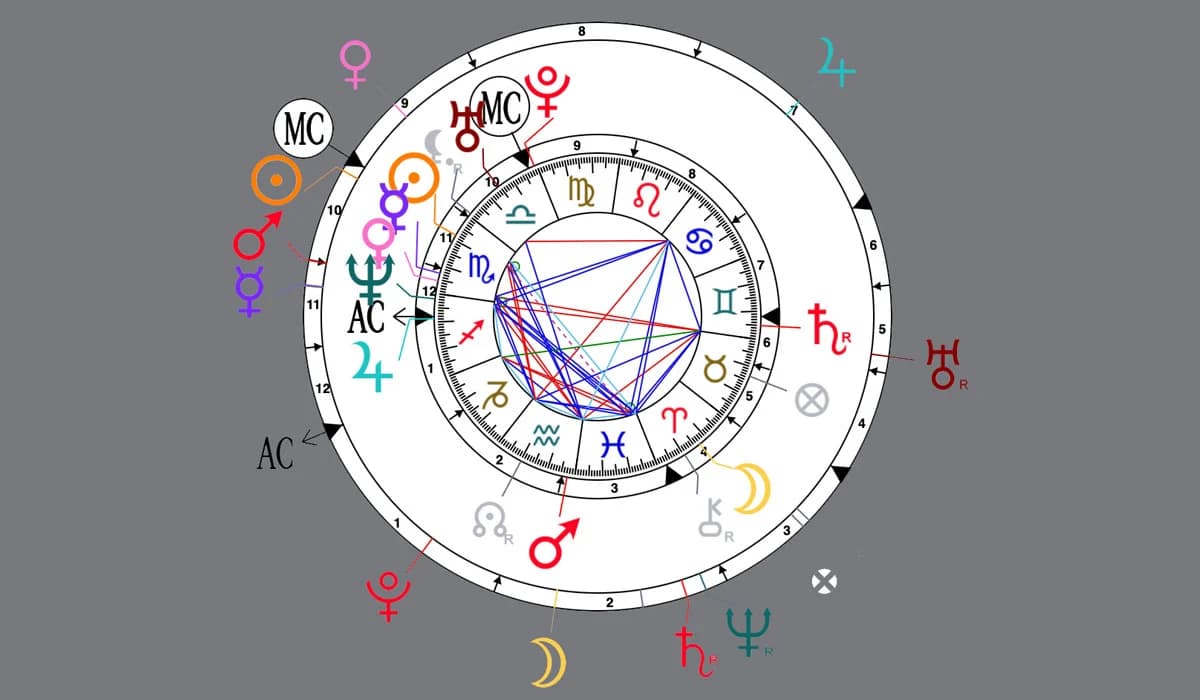
Your “birthday chart”: the weather of the year. We don't predict at random — we read an annual dynamic with method.
Pro method in 10 stepsHouse of the Sun and axes of the yearRuler of the Solar Return AscendantDominant planets & periodsPitfalls + best practices
Definition
The solar return is the birth chart cast at the exact moment when the Sun returns to its natal position each year, allowing you to forecast the major trends of the next 12 months thanks to the activated houses and transits.
Want to learn how to interpret your solar return to anticipate the year's events? Many beginner astrologers struggle to distinguish this annual chart from ordinary transits. This course reveals the complete method: calculation, location, pillars of reading and concrete examples to decode your SR like a professional.
What is a solar return in astrology?
Summary
The Solar Return (SR) is a chart calculated at the exact moment when the Sun returns to the same degree/minute as in your natal chart.
It describes the dynamic of the year: priorities, mood, life axes, opportunities and points to watch.
It is always read in connection with the natal chart and, ideally, with transits/progressions.
What it is not
A fixed fate: the SR shows trends, not an inevitability.
A chart “better” than the natal: the natal remains the foundation.
A general horoscope: the SR is individual.
How to interpret your solar return: the pro method
Golden rules
1) Always start from the natal chart (maturity, stakes, cycles).
2) Look at the SR Ascendant + its ruler: your style of year.
3) Look at the house of the SR Sun: your centre of gravity.
4) Prioritise the angles (ASC/DSC/MC/IC): what becomes concrete.
5) Study the SR Moon: needs, mood, security.
6) Spot the dominant planets (close to the angles, stelliums).
7) Read the major SR aspects (Sun/Moon/ASC ruler).
8) Look at the activated houses (1/4/7/10 + the Sun's house).
9) Cross-reference SR ↔ Natal: where it “lands” for you.
10) Finish with a synthesis: 3 major themes + 3 practical tips.
Checklist
House of the SR Sun = central theme of the year
Ruler of the SR ASC: where the energy goes (house) + how (aspects)
SR Moon: mood + security + relational needs
Planets on angles: concrete events
Stellium: “overloaded” zone (priority)
Saturn: responsibilities / structure
Jupiter: growth / opportunities
Uranus: changes / freedom
Neptune: haze / inspiration
Pluto: intensity / transformation
Recommended orbs
Planets on angles (ASC/DSC/MC/IC)
up to 3° (4° if very telling)
Sun/Moon
4° to 5°
Personal planets
3° to 4°
Social / Transpersonal
2° to 3°
The pillars of reading an annual solar return
SR Ascendant & ASC ruler
The SR Ascendant shows the tone of the year. The ASC ruler tells where the energy will concentrate and how you react.
Key points
SR ASC = attitude, style, way of approaching the year.
ASC ruler in an SR house = main activated area.
ASC ruler aspected = ease/challenge + style of integration.
ASC ruler on an angle = a very “visible” and concrete year.
To do
Identify the house of the ASC ruler (area no. 1).
Read its main aspects (2 or 3 max).
Compare with the natal: which sector does the SR “press on” for you?
House of the SR Sun
The SR Sun indicates the centre of gravity: what you must develop, take on, bring to life.
Key points
The area of the Sun's house becomes the priority.
Aspects to the Sun = ease / tensions that structure the year.
Sun close to an angle: a pivotal year.
To do
Note the house of the SR Sun + the sign (style).
Look for the links with your natal (activated natal house).
The SR Moon
The SR Moon speaks of lived experience: emotions, security, needs, pace of life.
Key points
House of the Moon = what touches the intimate and the everyday.
Moon aspects = emotional climate (soothed or reactive).
Moon linked to Saturn/Neptune/Pluto: maturity, haze or intensity.
To do
Define your lunar need for the year (security, affection, freedom…).
Set up 1 weekly regulating ritual (sport, rest, writing…).
Angles & dominant planets
The angles make the year concrete. Planets close to the angles become “dominant”.
Key points
Planet on MC: career, direction, visibility.
On IC: family, home, roots, intimacy.
On DSC: partnership/associations/contracts.
On ASC: identity, body, health, lifestyle.
To do
List the planets within 3° of an angle.
Choose 1 to 2 dominants max for your “thread”.
Cross-referencing SR ↔ Natal
The SR alone can be vague. Cross-referencing shows “where it actually lands” for you.
Key points
Overlay the houses: SR house X falls into which natal sector?
SR aspects to natal planets: triggers and themes.
SR angles on natal planets: a decisive year.
To do
Compare the house of the SR Sun with your natal.
Compare the SR ASC ruler with your natal (aspects/house).
Examples of solar return interpretation
01
A “professional” year
SR Sun in house 10, dominant planet on MC, structuring aspects to Saturn: responsibilities, visibility, choices of direction. The key: frame and prioritise.
02
A “relational” year
SR ASC in Libra, planets in house 7, ASC ruler in 7: partnership/associations at the centre. The key: clear contracts, communication (Mercury) + boundaries (Saturn).
03
An “inner / transformation” year
Pluto/8 dominant or a loaded IC: sorting out, end of a cycle, deep emotional work. The key: sobriety, therapy/writing, and simplification.
Frequently asked questions about the solar return
Does the SR begin on my birthday?
It begins at the exact moment of the solar return (which can be before/after the time of birth). In practice: around the birthday.
Should I calculate the SR where I live or where I was born?
Generally, you calculate the SR for the place where you are at the moment of your birthday (or where you spend the solar return). This changes the houses, and therefore the emphasis of the year.
How do you find the “ruling planet of the year”?
Often: the SR ASC ruler + the dominant planets (on angles). Avoid having 5 of them: choose 1 to 2 pillars.
Frequently asked questions about the solar return
Does the solar return begin on my birthday?+
The solar return begins at the exact moment of the solar return, which can occur a few hours before or after the time of birth. In practice, it falls around your birthday. This return marks the start of your personal astrological year.
Should the SR be calculated at your place of residence or place of birth?+
The solar return is generally calculated for the place where you are at the moment of your birthday. This changes the astrological houses, and therefore the thematic emphasis of the year. Some astrologers deliberately travel to optimise their SR.
How do you find the ruling planet of the year in a solar return?+
The ruling planet of the year is often the ruler of the SR Ascendant, combined with the dominant planets placed on the angles. The ideal is to focus on 1 to 2 pillars rather than scattering the analysis across 5 planets.
What is the difference between a solar return and transits?+
Transits describe the current planetary movements relative to your natal chart and are precise in time. The solar return offers an overview of the trends for the whole year. The two techniques complement each other: the SR gives the framework, the transits pin down the calendar.