Why Renaissance physicians read the sky
A history of medical astrology: why Middle Ages and Renaissance physicians read the sky before treating patients. A historical account (not medical).
When to heal was first of all to read the sky
For nearly fifteen centuries, a European physician worthy of the name did not merely examine his patient: he also consulted a chart of the sky. Far from being a charlatan's whim, medical astrology was taught at university, woven into learned thought from Hippocrates to the Renaissance. Here is the story of this alliance between the sky and the body — and the reasons, perfectly logical for the time, that made it indispensable.
Framework of thought
The 4 humours
Emblematic tool
The zodiac man
Key star for timing
The Moon
To understand why a doctor in 1550 opened his ephemeris before his medical bag, you have to forget modern medicine and enter a vision of the world in which everything hangs together: the sky and the earth, the great universe and the little universe that is the human body. In this logic, reading the stars was not "believing in your horoscope" — it was applying the most serious science of its time.
1) The body as a "little world"
The master idea fits in a single word: correspondence. For the medieval and Renaissance scholars, the human being was a microcosm, a universe in miniature that reflected the great macrocosm of the sky. What played out up there inevitably resonated down here, in the flesh.
This intuition was not absurd to observation. The Sun governs the seasons, hence the fevers and the harvests. The Moon governs the tides: why not, then, the liquid "humours" of the body? From this analogical reasoning is born a medicine in which the sky serves as a calendar and a compass.
2) The four humours, the foundation of all medicine
Before astrology, there is a medical theory: that of the humours, inherited from Hippocrates (5th century BC) and then codified by Galen in the 2nd century. According to it, health is the balance of four fluids; illness, their imbalance. The whole work of the physician consisted in restoring the balance.
Here we recognise a vocabulary still alive today: to call someone "sanguine", "phlegmatic" or "melancholic" is to speak of the humours without knowing it. It is precisely here that astrology plugs into medicine: each planet and each sign carries the same qualities — hot/cold, dry/moist — as the humours. The sky becomes a grid for reading the patient's temperament.
3) The zodiac man: the body mapped by the signs
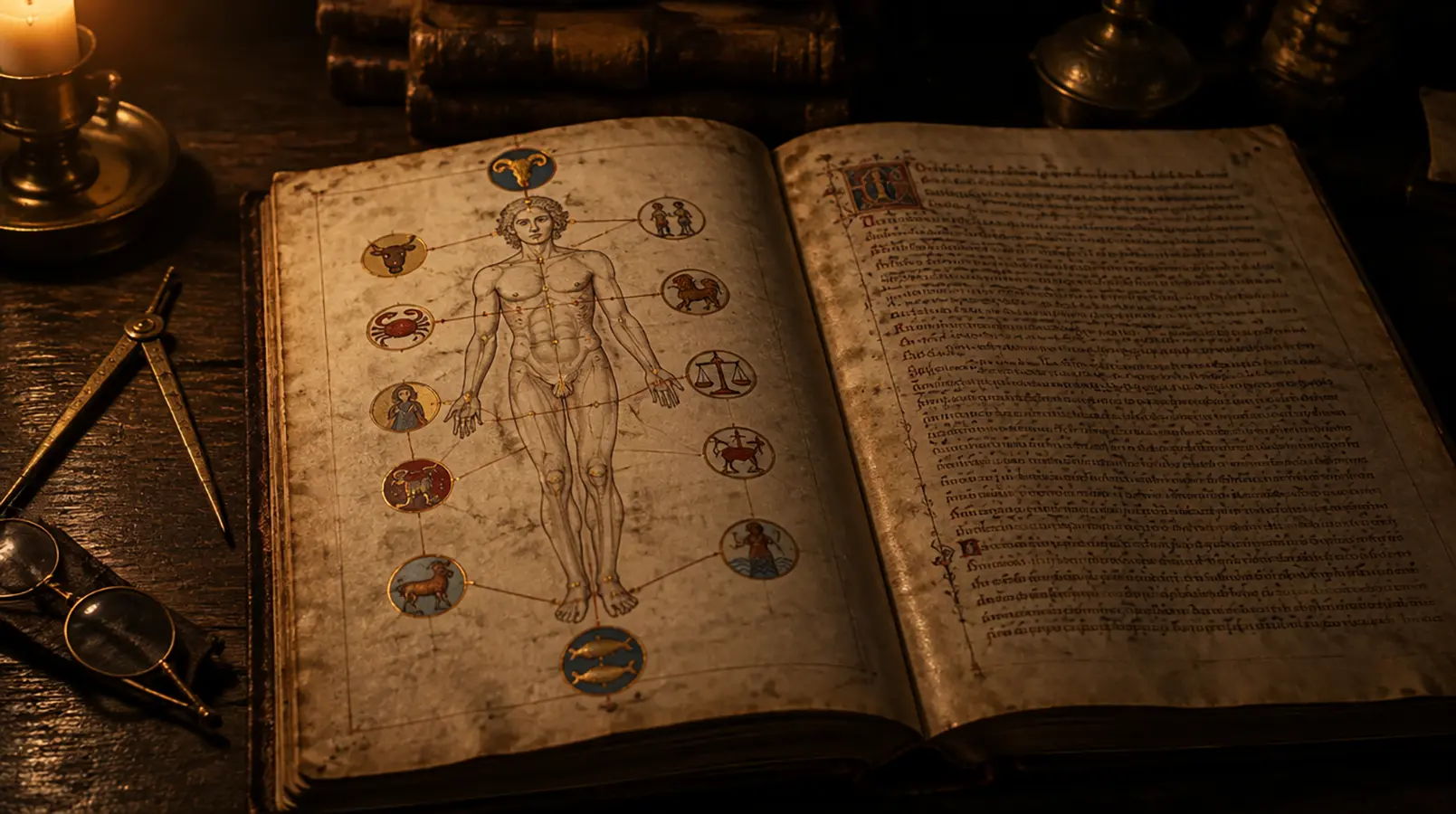
The most famous image of this medicine is the "zodiac man" (homo signorum, the "man of the signs"). It is found everywhere: in illuminated manuscripts, such as the Très Riches Heures du Duc de Berry, and then in the printed almanacs sold by the thousand. The principle is simple and visual: each sign governs a region of the body, from top to bottom.
From head to feet
The zodiac laid over anatomy.
Aries rules the head, Taurus the throat, Gemini the arms and lungs, Cancer the chest… and so on down to Pisces, which rules the feet. The whole body was thus covered, sign after sign.
A memo, not a decoration
What this image really served for.
The zodiac man was a practical memory aid. The golden rule: intervene on a part of the body only when the Moon was not passing through the sign that governs it. One avoided, for example, bleeding the arm when the Moon was in Gemini.
This correspondence of signs and organs remains the backbone of the tradition. It is found, explained in detail, in the complete dossier on medical astrology, alongside the temperaments and the houses known as "the houses of health".
4) Choosing the right moment: the Moon and the "critical days"
The great concern of medical astrology was not so much the what as the when. Bloodletting, purge, administering a remedy, gathering plants: each act had its favourable moment, and the Moon, the swiftest of the heavenly bodies, was its great regulator.
The critical days
Inherited from Hippocrates, read in the sky.
Hippocrates had already observed that fevers evolved in stages — the famous critical days. The astrologer-physicians tied them to the lunar cycle: the Moon returning roughly every seven days to a major aspect, they saw in it the key to the phases of worsening or improvement.
The decumbiture
A chart for the moment one falls ill.
A more technical practice, the decumbiture consisted in drawing up a chart of the sky for the exact moment the patient took to his bed (or for the taking of a urine sample). In it one sought the prognosis: recovery, relapse, or a grave outcome. The English physician Nicholas Culpeper left, in the 17th century, detailed examples of it.
5) Why the Renaissance believed in it so strongly
Far from retreating, medical astrology reached its apogee in the 15th and 16th centuries. The printing press disseminated almanacs and bloodletting calendars on a large scale; the universities — Bologna, Paris, Montpellier — taught astrology to future physicians as a normal discipline of the curriculum.
Ficino and melancholy
In Florence, Marsilio Ficino wrote the De vita, a health manual for "Saturnian" intellectuals, seeking jovial and solar remedies for an excess of black bile.
Paracelsus, the iconoclast
Paracelsus overturns Galen but keeps the sky: for him, the physician must know astronomy as much as the chemistry of remedies. The star and the mineral answer each other.
A scholarly requirement
Certain faculties required notions of astrology in order to practise. Consulting the sky was not marginal: it was the norm of the learned physician.
Why this allegiance? Because the system was coherent, teachable and socially useful. It gave meaning to illness, reassured the sick, provided a prognosis and connected the body to a cosmic order shared by the whole culture of the time — theology, music, architecture included.
6) The decline — and what remains of it
From the 17th century onwards, everything changes. The experimental method, the discovery of the circulation of the blood by Harvey, then the rise of anatomy and chemistry render the theory of the humours progressively untenable. The sky ceases to be an instrument of healing to become an object of pure astronomy.
But the legacy is not entirely erased. It survives in the language (a "lunatic", "saturnine", "jovial" character), in the history of ideas, and in the symbolism that contemporary astrology continues to explore — not to heal, but to describe temperaments and psychological terrains.