The basics · Zodiac
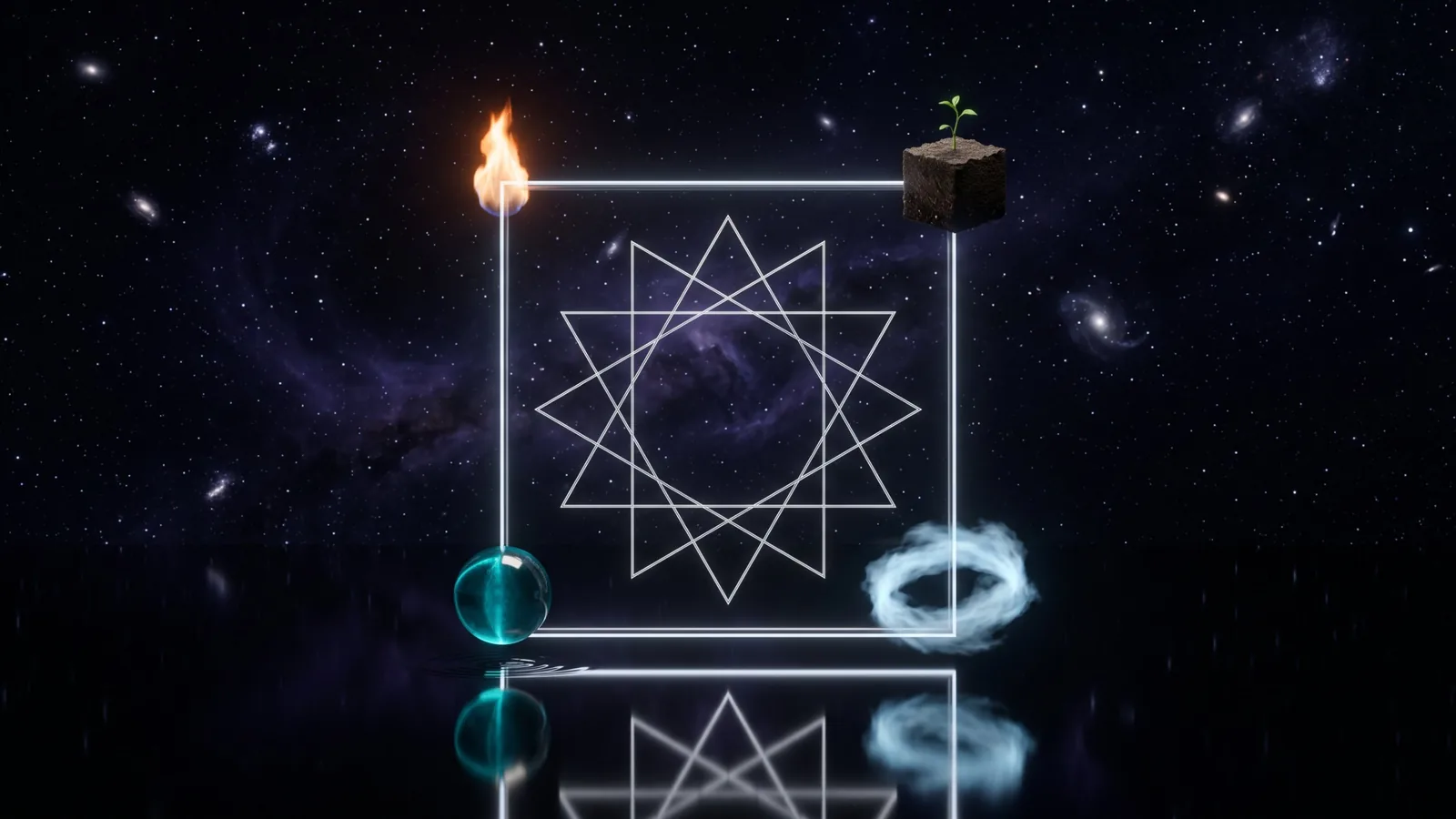
The four elements of the zodiac: fire, earth, air and water
Three signs per element, four ways of working, and a method to measure the share of each one in a chart, beyond the Sun sign.
The short answer
The twelve signs of the zodiac fall into four elements, three signs each: fire (Aries, Leo, Sagittarius), earth (Taurus, Virgo, Capricorn), air (Gemini, Libra, Aquarius) and water (Cancer, Scorpio, Pisces).
Each element describes a way of working: fire acts, earth builds, air connects, water feels. Your element cannot be read from the Sun sign alone: it is counted across the whole chart, Moon and Ascendant included.
Key takeaways
- Four elements, three signs each, always in the same order around the wheel: fire, earth, air, water. The same element comes back every fourth sign.
- Each element rests on two of Aristotle’s qualities: fire is hot and dry, earth cold and dry, air hot and moist, water cold and moist.
- Crossed with the three modes (cardinal, fixed, mutable), the four elements give twelve combinations, one per sign.
- Your element can be counted: Sun, Moon and Ascendant 3 points, chart ruler and angular planets 2, other planets 1. Above 40%, the element dominates.
- From 1940 to 2025, 4 to 7% of births have no planet at all in a given element. From 2027 to 2032, one birth in five will have no planet in water.
Which sign, which element?
A sign’s element comes from its place in the wheel, never from its name, its symbol or its planet. Aquarius, despite its name, is an air sign; Scorpio, despite Mars, is a water sign; Capricorn, despite its fish tail, is an earth sign.
| Element | Signs | Qualities | Temperament | Function (Jung) | In one verb |
|---|---|---|---|---|---|
| Fire | Aries, Leo, Sagittarius | hot and dry | choleric | intuition | act |
| Earth | Taurus, Virgo, Capricorn | cold and dry | melancholic | sensation | build |
| Air | Gemini, Libra, Aquarius | hot and moist | sanguine | thinking | connect |
| Water | Cancer, Scorpio, Pisces | cold and moist | phlegmatic | feeling | feel |
The system is twenty-five centuries old. Empedocles posits four “roots” of all things, Aristotle describes each by two qualities, and Galen’s medicine derives four temperaments from them. Ptolemy, in the 2nd century, already describes the four triangles of signs that tradition ties to the elements. The link with Jung’s functions dates from the 20th century.
Fire, earth, air, water: the order of the wheel
Start from Aries and follow the wheel: fire, earth, air, water, then fire again with Leo, and so on to Pisces. The same element therefore comes back every fourth sign. Its three signs sit 120° apart and draw a triangle: this is the triplicity, and 120° is the angle of the trine.
Tradition also pairs the elements: fire and air, the so-called masculine or diurnal signs; earth and water, the so-called feminine or nocturnal signs. A fire sign and an air sign, like an earth sign and a water sign, always sit 60° or 180° apart: sextile or opposition. All of “element compatibility” comes out of this geometry.
Elements and modes: twelve combinations, one per sign
Three signs of the same element are less alike than the lists suggest: they share the element, not the mode. Cardinal starts, fixed sustains, mutable adapts. Four elements crossed with three modes give twelve combinations, one per sign.
The cardinal fire of Aries starts, the fixed fire of Leo sustains, the mutable fire of Sagittarius spreads: same material, three gestures. Each element page looks at its three signs this way.
The four elements, one by one
Each element has its own page: its three signs, what it means, the method to count it in a chart, and computed figures the usual lists never give.
Fire
ActA way of spending energy: outward, first, and fast. Drive, a need to act, warmth that spreads to others. Its reverse: impatience and overheating.
5% of births with no planet in fire on average, up to 38% in 2021.
Earth
BuildA way of meeting reality: through what can be touched, measured and made to last. A sense of the concrete, patience, a taste for finished work. Its reverse: rigidity and trouble letting go.
7.3% of births without earth; in 49 years out of 86, nobody is born without earth.
Air
ConnectA way of relating to the world: through thought, speech and exchange. Curiosity, a sense of nuance, a need to understand. Its reverse: scattering and indecision.
From 2025 to 2042, no birth without air: the longest run since 1940.

Water
FeelA way of taking the world in: through what is felt, before any analysis. Sensitivity, emotional memory, empathy. Its reverse: touchiness and withdrawal.
The element least often missing (4.3%), and yet the record: 40% in 1997.
What element am I? The weighted count
The Sun sign gives an element, not yours. A chart holds about a dozen positions, and each one has its own. To find out which dominates, you weight and add up, with the same grid as for the dominant signs.
| Position | Points |
|---|---|
| Sun, Moon, Ascendant | 3 each |
| Chart ruler, planet conjunct an angle (within 8°) | 2 |
| Any other planet | 1 |
| Planet in domicile or exaltation | +1 |
Total each element, then work out its share of the overall total. Above 40%, the element dominates the chart; below 10%, it is weak. Without a birth time, count the Sun and the Moon at 3 and the other planets at 1. The same logic, extended to the planets, gives the dominant planet.
One chart, four readings
The chart used as the example on all four element pages (November 1, 1971, 10:15 a.m., Troyes, France) has the Sun in Scorpio. For a horoscope column, it is a water chart. Counted, it tells another story.
| Element | Positions | Points | Share | What the count shows |
|---|---|---|---|---|
| Fire | 4 of 11 | 11 | 50% | Dominant, thanks to the Moon, the Ascendant and its ruler, even though the Sun is in a water sign. |
| Air | 4 of 11 | 6 | 27% | Numerous but light, and half generational: 18% without Uranus, Neptune and Pluto. |
| Water | 3 of 11 | 5 | 23% | The Sun sign, only third, but entirely personal: 29% without the slow planets. |
| Earth | 0 of 11 | 0 | 0% | Absent, by twenty-seven days: Pluto had just left Virgo. |
Four elements, four lessons: one that dominates without being the Sun sign’s, one that makes up the numbers without weighing much, one that weighs little but belongs to this chart alone, one that is missing. That is the point of counting instead of reading the sign.
The four elements in figures
Is having a lot of one element, or none at all, rare? We computed the positions of the ten planets, Sun to Pluto, four times a day from 1940 to 2025, more than 125,000 moments in all, with Swiss Ephemeris. The Ascendant, which depends on place and hour, is not part of this count.
| Element | No planet | 2 or 3 planets | 5 planets or more | Years when nobody is born without it | Record year |
|---|---|---|---|---|---|
| Earth | 7.3% | 49% | 10% | 49 out of 86 | 1946: 37.9% without earth |
| Air | 6.6% | 51% | 9% | 52 out of 86 | 1986: 32.4% without air |
| Fire | 5.0% | 55% | 7% | 60 out of 86 | 2021: 37.8% without fire |
| Water | 4.3% | 55% | 7% | 58 out of 86 | 1997: 40.3% without water |
It all depends on the slow planets. When Uranus, Neptune or Pluto crosses a sign of an element, nobody is born without that element for years. When none of them is there, the share of charts lacking it climbs to 30 or 40%. A generation’s element can be read in the sky of its time.
The 2027–2032 generation
From 2027 to the summer of 2032, all three slow planets are in a fire or air sign: Neptune in Aries, Uranus in Gemini, Pluto in Aquarius. Fire and air are guaranteed at every birth. Earth and water come only from the other seven planets, from the Sun to Saturn.
| Element | Births with no planet, 2027–2032 | 1940–2025 average | Slow planet in the element |
|---|---|---|---|
| Fire | 0% | 5.0% | Neptune in Aries |
| Air | 0% | 6.6% | Pluto in Aquarius, Uranus in Gemini |
| Earth | 10.5% | 7.3% | None |
| Water | 20.2% | 4.3% | None before August 2032 |
One birth in five with no planet in water, nearly five times the average: for those children, a Sun, a Moon or an Ascendant in a water or earth sign will weigh all the more. Our overview of the major transits of 2027 details these three passages.
Element compatibility: the rule and its limits
The popular rule says: fire with air, earth with water. It is not wrong, but it is an aspect rule that does not say its name. Two signs of the same element are in trine (120°). Fire and air, earth and water are in sextile (60°) or in opposition (180°). The other pairings land on the square, the quincunx or the semi-sextile.
Its limit: it compares only two Sun signs, two positions out of about twenty. A Moon or a Venus in the other person’s element changes the whole picture. The method that takes this into account is synastry; our compatibility pages by sign pair give a first approach.
Frequently asked questions about the zodiac elements
What are the four elements of the zodiac?
Fire, earth, air and water. Each one groups three zodiac signs: fire (Aries, Leo, Sagittarius), earth (Taurus, Virgo, Capricorn), air (Gemini, Libra, Aquarius) and water (Cancer, Scorpio, Pisces). Around the wheel they always follow one another in that order, so the same element comes back every fourth sign.
What element am I?
Your Sun sign gives a first answer, but your real element is counted across the whole chart. Give 3 points each to the Sun, the Moon and the Ascendant, 2 to the chart ruler and any planet conjunct an angle, 1 to every other planet, +1 in domicile or exaltation. The element above 40% of the total dominates, and it can differ from your Sun sign’s.
What element is my zodiac sign?
Aries, Leo and Sagittarius are fire signs. Taurus, Virgo and Capricorn are earth signs. Gemini, Libra and Aquarius are air signs. Cancer, Scorpio and Pisces are water signs. Aquarius, the Water-Bearer, is air, not water; Scorpio, ruled by Mars, is water, not fire.
Which zodiac elements are compatible?
The classic rule pairs fire with air and earth with water: their signs are in sextile (60°) or in opposition (180°). Two signs of the same element are in trine (120°). Fire and earth, fire and water, air and earth, air and water are said to be harder. The rule compares Sun signs only; synastry compares the two whole charts.
Can a birth chart be missing an element?
Yes, and it is not rare. From 1940 to 2025, 4.3% of births have no planet in a water sign, 5.0% in fire, 6.6% in air and 7.3% in earth. The missing element is not simply absent: it often comes back through the Ascendant, through the houses that match it, or through the people one chooses.
Where do the four elements come from?
From Greek philosophy. Empedocles, in the 5th century BCE, posits four roots of all things: fire, earth, air and water. Aristotle describes each by two qualities, hot or cold, dry or moist, and Galen’s medicine derives four temperaments from them. Astrology inherits them when it ties its triangles of signs to the elements.
Sources
- Figures for 1940–2025 and 2027–2032: author’s calculations, positions of the ten planets at 0h, 6h, 12h and 18h UT for every day, with Swiss Ephemeris (Moshier ephemeris), 125,648 moments for 1940–2025. Real births are not spread evenly over the year; the gap with the daily average stays under one percentage point.
- Example chart: November 1, 1971, 10:15 a.m., Troyes, France, legal time UTC+1, Placidus, tropical.
- Empedocles, fragment B 6 (Diels-Kranz): the four roots. Aristotle, On Generation and Corruption, II, 3: the elements and their qualities. Galen, On Temperaments.
- Ptolemy, Tetrabiblos, I, 18, “Of the Triangles”.
- Stephen Arroyo, Astrology, Psychology and the Four Elements, CRCS Publications, 1975.